

Technology
Node.js development.
Backends that answer quickly and fail loudly, not silently.
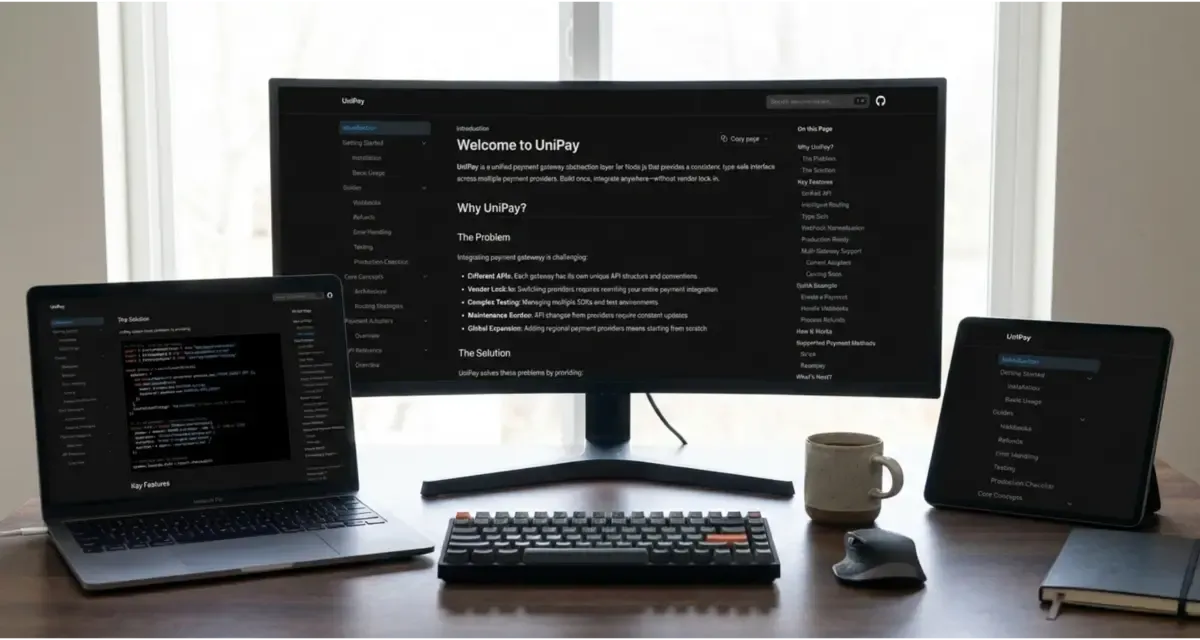
MeetOnChai Studio builds Node.js backends in TypeScript: REST and GraphQL APIs, payment integrations, webhooks and real-time features. UniPay, our open-source payment layer that unifies Stripe and Razorpay behind one typed interface, is built on Node.js.
Why we use it
Why Node.js, and when not.
Most business backends spend their time waiting: on the database, on a payment gateway, on an email provider. Node.js is built for exactly that kind of I/O-heavy work, and it handles lots of concurrent requests on modest hardware. That makes it a natural fit for APIs, webhook receivers and anything real-time.
The bigger win is one language across the whole product. With TypeScript on the server and the client, types for an order or a user are defined once and shared, so a field renamed on the backend shows up as an error in the frontend before it reaches production. It also means the same developers can move between layers without a handover.
When it's the wrong call: Node.js is the wrong tool for heavy CPU work in the request path, such as video encoding, large numeric computation or machine learning training. Those belong in Python, Go or a dedicated worker. And if your team is already deep in Django, Laravel or .NET and it works, switching to Node.js for its own sake is not worth the disruption.
What we build
What we build with Node.js.
- 01
REST and GraphQL APIs
Well-typed, documented APIs for web and mobile clients, with auth, validation and rate limiting built in.
- 02
Payment and webhook services
Integrations with Stripe, Razorpay, eSewa and Khalti, with idempotent webhook handling so a retried callback never charges twice.
- 03
Real-time features
Live order status, chat and notifications over WebSockets or server-sent events.
- 04
Background jobs and queues
Emails, invoices, report generation and syncs that run off the request path and retry on failure.
- 05
Third-party integrations
Connecting your system to WhatsApp, SMS gateways, ERPs, courier APIs and accounting tools.
- 06
Backends for mobile apps
Auth, push notifications, file uploads and sync endpoints sized for apps on flaky mobile networks.
The stack around it
What it ships with.
- Runtime and framework
- Node.js LTSTypeScriptFastifyExpressNestJS
- Data
- PostgreSQLMongoDBRedisPrisma or Drizzle
- APIs
- RESTGraphQLZod validationOpenAPI
- Infrastructure
- DockerAWSVercel FunctionsGitHub Actions
Honest comparison
Node.js vs the alternatives.
vs Python (FastAPI or Django)
Better when the backend sits next to data science or ML code. For a typical product API, Node.js and Python are both fine, and sharing TypeScript with the frontend tips it to Node.
vs Go
Faster and leaner for high-throughput services. It is more code for the same feature, so we reach for it when performance is the main requirement, not by default.
vs PHP (Laravel)
Mature, productive and cheap to host. If you already have a Laravel team, keep it. For a new product with a React frontend, one language end to end usually saves time.
Services
Services that fit.
- Web App DevelopmentNext.js web apps and SaaS products that hold up under real traffic.
- Payment Gateway & API IntegrationeSewa, Khalti, UPI, Razorpay and Stripe integrations with webhooks done right.
- SaaS DevelopmentMulti-tenant SaaS with accounts, roles and subscription billing built in from day one.
- DevOps & DeploymentCI/CD, hosting, monitoring and rollbacks, so launch day is boring.
- MVP & Product DevelopmentThe smallest real version of your product, in front of users in 4-8 weeks.
FAQ
Node.js questions.
Which Node.js framework do you use?
It depends on the job. Fastify for lean, fast APIs, NestJS when a larger team needs strong structure, and plain route handlers inside Next.js when a separate backend would be overkill. We would rather pick the smallest thing that works than force one framework everywhere.
Can Node.js handle payments safely?
Yes, if it is built carefully. We verify every payment on the server, check webhook signatures, make handlers idempotent so retries do not double-charge, and keep secrets out of the codebase. That approach is what UniPay was designed around.
Can you connect our backend to eSewa, Khalti or Razorpay?
Yes. We have worked with Stripe and Razorpay, and with eSewa and Khalti for Nepali customers. If you need more than one, we put them behind a single interface so adding a gateway later does not mean rewriting checkout.
Where will the backend be hosted?
Small APIs often run fine as serverless functions on Vercel. Long-running services, queues and WebSockets go on AWS or a container host with Docker. We choose based on your traffic and budget, and document it so you are not locked to us.
Can you fix a slow Node.js API?
Usually, yes. The cause is most often the database: missing indexes, N+1 queries, or no caching. We profile before we change anything, so the fix targets the real bottleneck instead of a guess.
Every project starts with a conversation
Got an idea? Let's talk over chai.
A free 15-minute call. No pitch deck, no obligation. You leave with an honest read on what to build first.
- We reply within 24 hours, usually much sooner.
- NDA signed before you share the details.
- Based in Kathmandu, working with Nepal, India and worldwide.